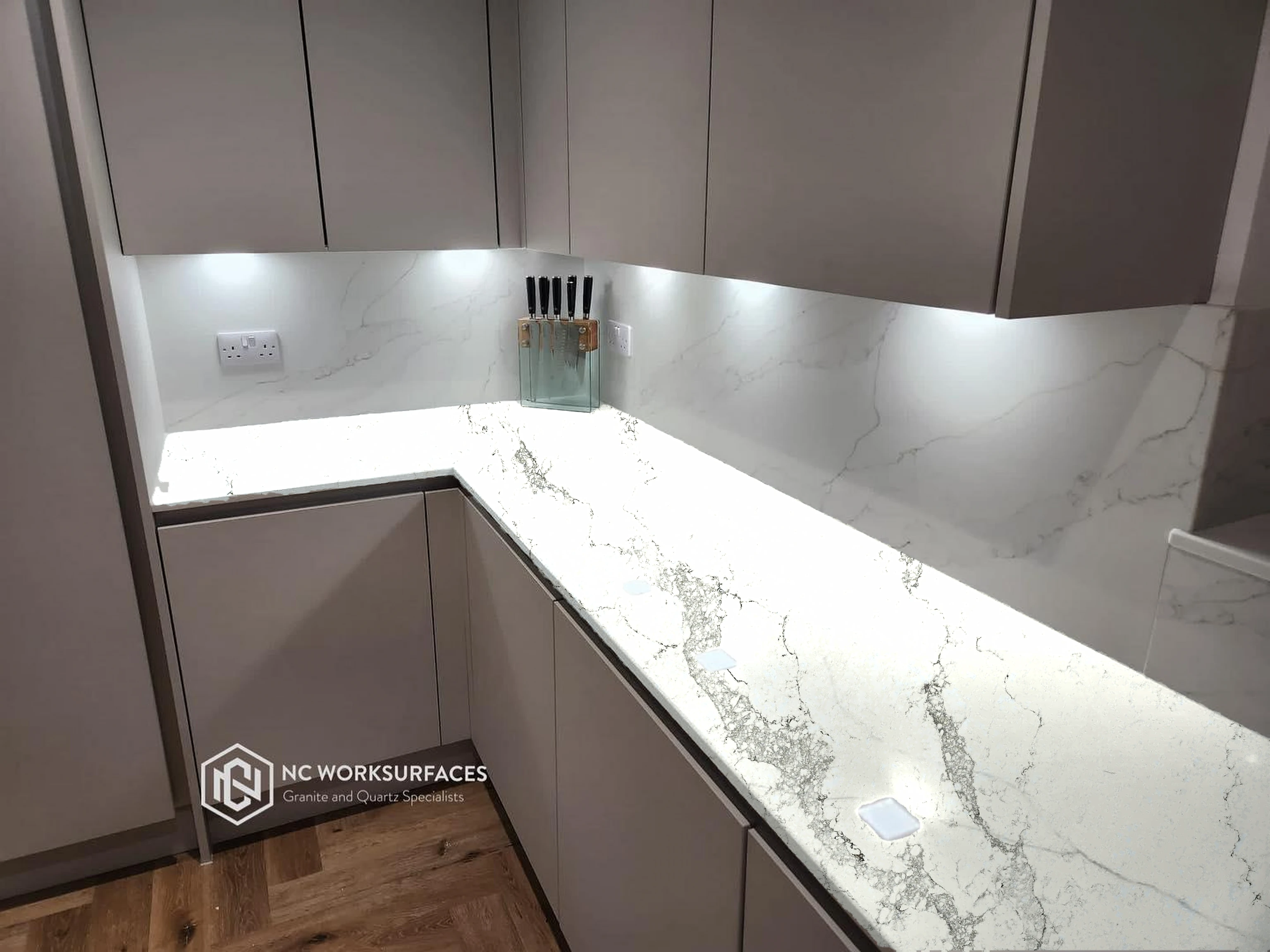
Costs & planning
How much do worktops cost in the UK?
An honest, indicative guide to UK worktop prices — what drives the cost, what a quote includes, and why a firm figure only comes after a survey.
“How much will my worktop cost?” is the first question almost everyone asks — and the honest answer is it depends, because no two kitchens are the same. What we can do is give you realistic, indicative ranges from published UK guides, explain what moves the number, and be straight about why a firm price only comes after a survey.
A note on every figure below: these are indicative ranges from public 2025/2026 cost guides, cited as we go. They are not a quote. Your actual price is confirmed after a templating survey of your kitchen.
Indicative UK ranges
For quartz, published 2025 cost guides put the typical figure around £350–£450 per m² supplied and installed, with the full range spanning roughly £165 to over £1,000 per m² once you account for colour, thickness and brand (WorktopLibrary).
For granite, Checkatrade’s guide puts the material broadly in the £250–£500 per m² range, sitting close to quartz, with premium colours costing more (Checkatrade).
The headline to take away: the colour and thickness you choose usually matter more than the material name. A premium veined quartz can cost more than a mid-range granite, and vice versa.
What actually drives the price
A few things move the number far more than people expect:
- Thickness. A 30mm slab uses noticeably more stone than 20mm, so it costs more — in material, weight and handling.
- Colour and pattern. Plain colours sit at the lower end. Heavily veined marble-effect designs and rare colours sit higher because they are harder to manufacture and match across joins (WorktopLibrary).
- The amount of stone. Bigger kitchens, islands and breakfast bars need more slabs.
- Cut-outs and edges. Sink and hob cut-outs, drainer grooves and fancier edge profiles add fabrication time. See our edge profiles guide for which edges cost more.
- Installation. Templating and fitting are skilled work. MyJobQuote’s guide treats installation as a distinct line item on top of the slab (MyJobQuote).
What a good quote includes
When you compare quotes, make sure you are comparing like for like. A complete quote should cover:
- Templating — precise on-site measuring, not a guess from your plans
- Fabrication — cutting the slab and forming the edge profile
- Cut-outs — for sink, hob and any tap holes
- Delivery and installation
- Ideally, upstands or splashbacks, and removal of the old worktop — always check whether these are in or extra
A suspiciously low “per m²” figure often leaves several of these out, so the totals end up closer than they first appear.
Why we only commit after a survey
We could print a tempting headline price, but it would not be honest, because we would not yet know your exact dimensions, the number of slabs, your edges and cut-outs, or access to your kitchen. Instead, we measure properly, then give you one clear figure you can rely on.
If you want a sense of where you’ll land before booking, build the look you like in the visualiser — material, edge and layout — and bring it to your survey. Start below.
Frequently asked questions
- How much does a quartz worktop cost per square metre in the UK?
- Published 2025 UK cost guides put quartz commonly around £350–£450 per m² supplied and installed, with the full range spanning roughly £165 to £1,000+ per m² depending on colour, thickness and brand (WorktopLibrary). Treat these as indicative — your figure is confirmed after a survey.
- Is quartz more expensive than granite?
- They overlap heavily. Checkatrade's 2025/26 guide puts granite roughly £250–£500 per m² and quartz in a similar to slightly higher band, with premium colours in either material costing more. The colour and thickness you pick usually matter more than the material name.
- What is included in a worktop quote?
- A proper quote should cover templating (precise on-site measuring), fabrication, cut-outs for sink and hob, edge profiling, delivery and installation. Always check whether upstands, splashbacks and removal of the old worktop are included.
- Why does the same colour vary so much in price?
- Thickness is a big factor — a 30mm slab uses more material than 20mm. Brand, the rarity of the colour, the amount of veining, and how many slabs your kitchen needs all move the price. That is why a survey is the only way to give a firm figure.
Sources
Figures and material facts below are drawn from the sources listed. Any prices are indicative only and are confirmed after a site survey.